The mining and geology sectors are currently experiencing a massive shift toward data-driven workflows, and a recent wave of both research and commercial developments highlights just how fast this landscape is changing. A comprehensive new preprint on Artificial Intelligence for Mineral Exploration dives deep into this transformation. It explores how classical machine learning, deep learning, and advanced foundation models are being applied across the full exploration pipeline to tackle extreme label scarcity and integrate heterogeneous geoscientific data—moving the industry far beyond traditional, manual interpretation. Major macro-trends to watch for:
- 2D → 3D/4D: AI-for-minerals is moving beyond flat prospectivity maps towards models that represent the subsurface in three dimensions, with an emerging push to incorporate geological time as a fourth dimension. The goal is not simply to predict where mineralisation occurs, but to model the geological structures, processes and histories that produced it.
- Single-modality → multimodal: Most systems still analyse geology, geochemistry, geophysics, remote sensing and text separately, but the direction of travel is towards models that reason across all of them simultaneously. Ultimately, multimodal models could build a unified representation from everything from magnetic surveys and drill assays to geological maps and historical reports.
- Supervised → self-/semi-supervised: Known deposits provide a tiny and heavily biased training set, while enormous quantities of geological data remain unlabelled. Self-supervised, semi-supervised and positive–unlabelled approaches therefore offer a way to learn geological structure from the data itself before adapting those representations to prospectivity and exploration tasks.
- Static prediction → uncertainty-driven exploration: Rather than producing a prospectivity map and stopping there, newer approaches quantify what the model doesn’t know and use that uncertainty to guide further exploration. Active learning and Bayesian optimisation can therefore recommend the next survey, sample or drillhole based on where additional information would be most valuable.
- Bespoke models → foundation models and agents: The longer-term trajectory is away from models trained for one commodity, dataset or region towards reusable geoscience foundation models that transfer between tasks and terranes. Combined with tool-using agents, these could eventually ingest new exploration data, construct and revise geological hypotheses, identify information gaps and recommend what to do next.
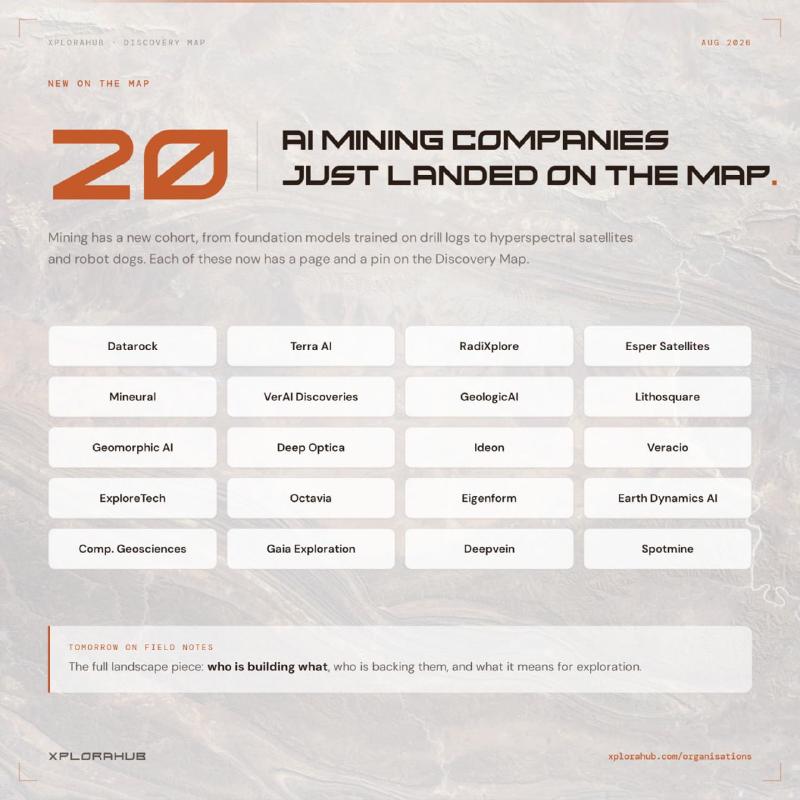
On the commercial front, this theoretical progress is rapidly turning into practical, on-the-ground applications. A fantastic recent piece over at Xplorahub highlights the ongoing rise of AI and ML companies in the mining sector. The article points out key innovators shaking up the industry, specifically noting the exciting developments from Eigenform and Nextmaps. These platforms are providing geologists, explorers, and resource investors with the advanced spatial analytics and ground intelligence needed to make fast, confident exploration decisions without drowning in disconnected datasets. Major macro trends to watch for:
- AI is clustering around the drill-targeting decision: The most crowded part of the market is exploration targeting, where AI has a straightforward economic proposition: reduce uncertainty before committing hundreds of thousands of dollars to drilling.
- Software → vertically integrated exploration: A growing group of companies is choosing not to sell its AI at all. Instead, they use proprietary models to identify opportunities, acquire mineral rights and monetise discoveries through JVs, royalties or direct mine ownership.
- Pure software → AI + proprietary data acquisition: Another branch of the industry is integrating models with the hardware needed to generate better or faster data: satellites, hyperspectral sensors, automated core scanners, muon detectors, robotic survey platforms and semi-autonomous drill rigs.
- Mining companies → strategic AI investors: Major miners such as BHP and Rio Tinto are increasingly behaving like venture investors rather than simply customers.
- Standalone startups → consolidation into mining-tech platforms: Established mining-technology companies are steadily acquiring specialist AI, sensing and data businesses, with IMDEX, Epiroc, ALS, Fleet Space, Veracio and others assembling broader technology stacks.
- AI claims → pressure for physical validation: The sector is awash with claims of faster exploration, fewer drill metres and better targeting, but comparatively few have yet been independently validated through economic discoveries.
If you want to understand exactly where the future of mineral prospectivity mapping and ground intelligence is heading, we highly recommend diving into these resources yourself. Check out the full technical breakdown in the preprint, and be sure to click through to Xplorahub to see how these cutting-edge AI tools are actively being deployed in the field today.